BROWNLEE, ROBERT WALLACE, JR.
Name: Robert Wallace Brownlee, Jr.
Rank/Branch: O5/US Army
Unit: Advisor Team 22, MACV
Date of Birth: 27 July 1921
Home City of Record: Chicago IL
Date of Loss: 25 April 1972
Country of Loss: South Vietnam
Loss Coordinates: 143858N 1074730E (ZB011211)
Status (in 1973): Missing In Action
Category: 1
Aircraft/Vehicle/Ground: Ground
Refno: 1834
Other Personnel in Incident: George W. Carter; Wayde L. Ellen; James E.
Hunsicker; Johnny M. Jones; Kenneth J. Yonan; Franklin Zollicoffer (all
missing); Charles M. Lea; Rickey V. Vogel (helicopter crew, rescued); Julius
G. Warmath; John P. Keller; Walter H. Ward (helicopter passengers, rescued);
Charles W. Gordon, Cao Ky Chi (evaded capture near Dak To)
Source: Compiled from one or more of the following: raw data from U.S.
Government agency sources, correspondence with POW/MIA families,
published sources, interviews. Updated by the P.O.W. NETWORK in 2020.
REMARKS: EVADED ACROSS DAK POKO RIVER
SYNOPSIS: On the evening of April 23, 1972, Capt. Kenneth J. Yonan
accompanied his ARVN counterpart to a water tower located on the
northwestern edge of the Tanh Canh base camp compound near Dak To, Kontum
Province, South Vietnam. Yonan was an advisor assigned to Advisory Team 22,
MACV, and was assisting the ARVN 42nd Regiment based there.
At about 0530 hours on April 24, Capt. Yonan was still in the water tower
when Viet Cong attacked the camp perimeter. Although tanks fired at and hit
the water tower, two other advisors spoke to Capt. Yonan after the firing
and Yonan reported that he was not hit and planned to join the other
advisors when it was safe to do so. Radio contact was maintained with Yonan
until 0730 hours. The other U.S. advisors began escape and evasion
operations from the beleaguered compound.
Team 22 Advisors Maj. George W. Carter, Maj. Julius G. Warmath, and Capt.
John P. Keller, were extracted by helicopter. The aircraft was a UH1H from
the 52nd Aviation Battalion, 17th Aviation Group, (serial #69-15715) and was
flown by Lt. James E. Hunsicker. WO Wade L. Ellen was the co-pilot of the
chopper, and SP4 Charles M. Lea, and SP5 Ricky V. Vogel were crewmen. Other
persons extracted included 1Lt. Johnny M. Jones, from the 52nd Aviation
Battalion; SP4 Franklin Zollicoffer, from the U.S. Army Installation at
Pleiku, and Sgt. Walter H. Ward, unit not specified.
The helicopter departed to the northwest from Dak To, but was apparently hit
by enemy fire, as it crashed and burned on a small island in the Dak Poko
River about 500 meters from the end of the dock to the runway. Because of
the rolling terrain, personnel at the airfield did not see the aircraft
impact. A pilot flying over the wreckage reported that the helicopter was
burning, but they could see no survivors. It was later discovered that five
people did survive the crash - Warmath, Keller, Vogel, Ward and Lea.
According to their statements, Hunsicker, Ellen, Zollicoffer, Jones and
Carter were all dead.
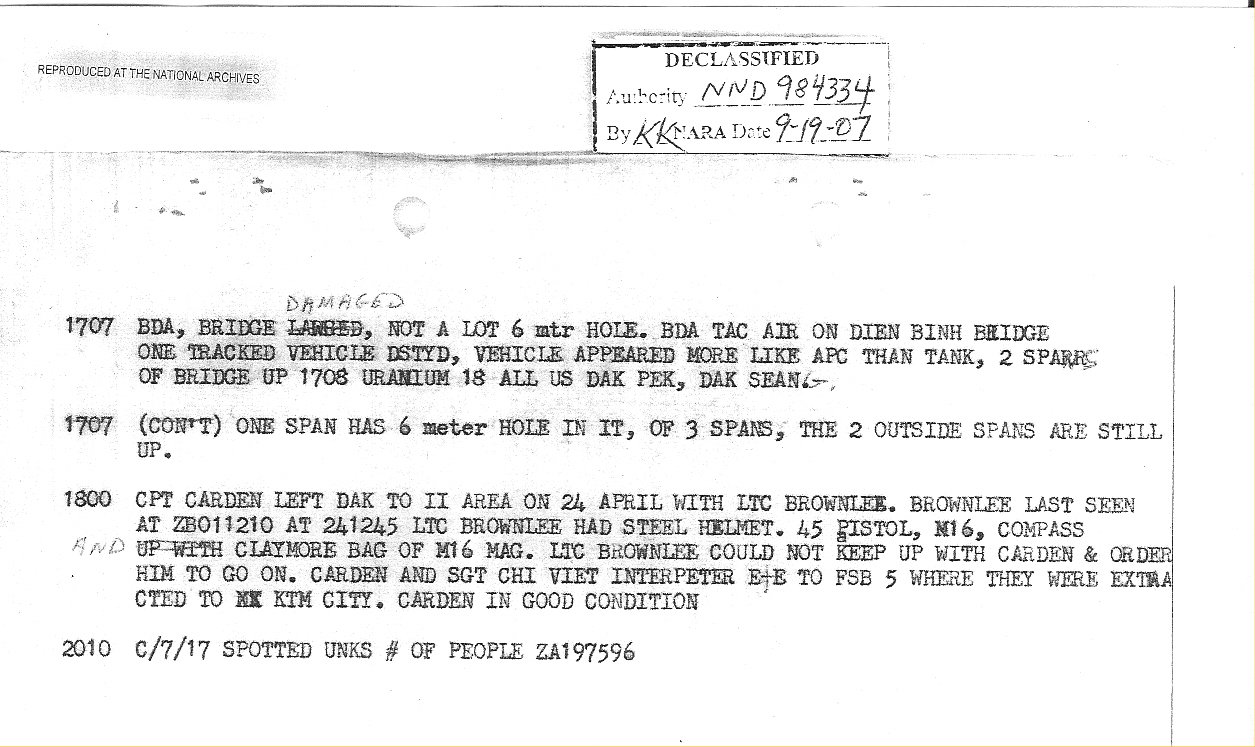
Two other Team 22, MACV Advisors, LtCol. Robert W. Brownlee and Capt.
Charles W. Gordon, and their ARVN interpreter, Sgt. Cao Ky Chi, were in a
bunker near the airstrip approximately 4 kilometers to the west of the base
camp when they were forced to withdraw under heavy enemy attack. They
proceeded south of the compound across the Dak Poko River, but LtCol.
Brownlee became separated from the others as they were advancing up a hill.
Sgt. Chi and Capt. Gordon called out to him, but received no response. From
the top of the hill, Sgt. Chi heard the enemy call out to someone in
Vietnamese to halt and raise their hands. Sgt. Chi believed the Viet Cong
were speaking to LtCol. Brownlee. Gordon and Chi evaded capture and
eventually made their way to safety.
A Vietnamese who was captured and subsequently released reported that he had
talked to another prisoner who had witnessed LtCol.Brownlee's death. He was
told that LtCol. Brownlee had killed himself with his own pistol when
communist soldiers told him to raise his hands in an attempt to capture him.
Additional hearsay reports of his suicide were reported by another ARVN
source.
Yonan never caught up with the others. For three days, helicopter searches
were made of the area with no success. Ground search, because of the hostile
threat in the area, was not practical.
In April 1988, the Vietnamese "discovered" the remains of Capt. Kenneth J.
Yonan and returned them to the U.S. in a spirit of stepped-up cooperation on
the POW/MIA issue. For nearly 20 years, this 1969 West Point graduate was a
prisoner of war - alive or dead. His family now knows with certainty that he
is dead, but may never learn how - or when - he died.
In addition to the reports regarding Brownlee's death, a South Vietnamese
soldier reported that he observed the capture of one "big" American from the
camp. Another report described the capture of a U.S. Captain stationed at
the camp.
Since the war ended, reports and refugee testimony have convinced many
authorities that not only do the Vietnamese possess several hundred sets of
Americans' remains, more startlingly, they also control hundreds of living
American prisoners.
As long as they are allowed to do so, the Vietnamese will return remains at
politically expedient intervals. As long as they are allowed to do so, they
will hold our men prisoner.
-------------------------
Official data bases do not tell the whole story of this mission.
While Rickey Von Vogel is only noted as "rescued", in reality, Sp5 Vogel was
missing from April 24, 1972 until his return to military control May 6,
1972. During that time, despite severe wounds that included bullet wounds
and broken bones, he managed to escape and evade capture for almost 2 weeks
until his rescue.
Rickey Vogel was awarded the Purple Heart and 3 Air Medals in addition to
various Vietnam awards and decorations for his service. After his medical
evacuation and recovery, he continued to serve his country until his
discharge in 1974.
----------------------------------
My interest in POW/MIA (returned) Kenneth Yonan is very personal. Some
of us
( D 1/12th Cav in AO at the time) were tasked to rescue him but
couldn't because
of the numerically superior enemy and armor.
Thought you may be interested to know of
this document
found at the Texas Tech
Archives. The archive document number is
actually the numerals within the named
file. View the very last page at the
bottom. Before Jimmy Gillespie ( my buddy in
D 1/12th Cav), who was with me
passed away he had reminded me of an American
who had come into our tiny AO
and stayed a bit and left. We never knew who he
was. We always wondered
if it could have been Ken Yonan or someone else.
So many records are
wrong or incomplete.
Note that Kenneth Yonan had previously been the CO of D 1/12th Cav before
he
transferred to Adv. Team 22. Captain Dombrosky replaced him at D 1/12th
and
in turn Captain John H. Wheeler replaced Capt. Dombrosky about mid
March
1972.
Best,
24 April 1972
"TAN CANH LOG
National
Archives Docs
MIA Lt Col Brownlee mentioned in this interview of 1990.
"...In Brownlee's case, his counterpart absolutely left him; he
gave no warning. His captain [US] got out - the were supposed to
relieve us at LZ Crystal when we went back to retake LZ English
our regiment was the one that retook it. But I had a chance to
talk to this captain and I know almost for a fact that Brownlee
was left behind. I stopped asking about it because I could see
in the captain's eyes that he had left him. I dropped the
subject. I just had the gut feeling that they had left him.
Brownlee had diarrhea, he was weak and couldn't keep up. They
crossed a stream and when they got to the other side they were
going through the bush and Brownlee allegedly told them that he
had to hole up and rest and the others were to go on ahead. They
went ahead, they heard some shots, they went back, they got shot
at and they left. I thought that was sick. But I haven't thought
about that in 10 years and it all comes back just clear as a
bell...."
|
~~~~~~~~~~~~~~~~~~~~~~~~~~~~~~~~~~~~~~~~~~~~~~~~~~~~~~~~~~~~~~~~~~~~~~~~~~~~~~~~
01/2020
COL ROBERT WALLACE BROWNLEE JR.
-
VIETNAM WAR
-
UNITED STATES ARMY
-
Unaccounted For
Lieutenant Colonel Robert Wallace Brownlee Jr., who joined the
U.S. Army from Illinois, served with Advisory Team 22,
Headquarters, Military Assistance Command, Vietnam (as US
advisors to the 47th Regiment, 22nd Division of the Army of the
Republic of Vietnam). On April 24, 1972, U.S. and South
Vietnamese forces at Dak To II, Kontum Province, South Vietnam
were attacked by North Vietnamese troops. Lt. Col. Brownlee, his
deputy, and a South Vietnamese interpreter were forced to
withdraw from a bunker under heavy enemy fire. They moved south
and attempted to cross the Dak Poko River. Lt. Colonel Brownlee
made it across the river, but then became separated from the
others in his group. His deputy last saw him at the base of the
riverbank on the south side of the river where Lt. Col.
Brownlee, who was wounded, motioned for him to go on. Although
separated from Lt. Col. Brownlee, the other two men hoped that
he could catch up and rejoin them. Both men called out for Lt.
Col. Brownlee several times, but the South Vietnamese
interpreter heard enemy forces call out in Vietnamese for
someone to halt and raise their hands. The proximity of North
Vietnamese forces and intensity of ground fire forced the deputy
and interpreter to continue their evasion, and the two never saw
Lt. Col. Brownlee again. His fate is unknown, and his remains
have not been recovered. After the incident, the Army promoted
Lt. Col. Brownlee to the rank of Colonel (COL.) Today, Colonel
Brownlee is memorialized on the Courts of the Missing at the
National Memorial Cemetery of the Pacific.
Based on all information available, DPAA assessed the
individual's case to be in the analytical category of Active
Pursuit.
If
you are a family member of this serviceman, DPAA can provide you
with additional information and analysis of your case. Please
contact your casualty
office representative.
Service member profile discrepancy? Please help us ensure the
accuracy of each profile by submitting
documentation about a service member profile.

COL ROBERT WALLACE BROWNLEE Jr.
-
Unit ADV
TEAM 22 MACV
-
Historical Country of Loss
South Vietnam
-
Current Country of Loss
VIETNAM
-
Home of Record IL