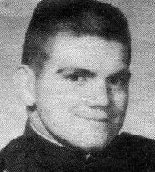
Name: Gray Dawson Warren
Rank/Branch: O3/US Air Force
Unit: 435th Tactical Fighter Squadron, 8th Tactical Fighter Wing
Date of Birth: 22 May 1942
Home City of Record: Des Moines IA
Date of Loss: 26 October 1969
Country of Loss: Laos
Loss Coordinates: 171300N 1060800E (XE212041)
Status (in 1973): Missing In Action
Category: 2
Aircraft/Vehicle/Ground: F4D
Refno: 1505
Other Personnel In Incident: Neil S. Bynum (missing)
Source: Compiled by Homecoming II Project 15 June 1990 from one or more of
the following: raw data from U.S. Government agency sources, correspondence
with POW/MIA families, published sources, interviews. Updated by the P.O.W.
NETWORK 2020.
REMARKS:
SYNOPSIS: When North Vietnam began to increase their military strength in
South Vietnam, NVA and Viet Cong troops again intruded on neutral Laos for
sanctuary, as the Viet Minh had done during the war with the French some
years before. The border road, termed the "Ho Chi Minh Trail" was used for
transporting weapons, supplies and troops.
The communists poured through the Mu Gia, Bartholemy and Ban Karai Passes in
the mountains along the border of Laos and Vietnam and went over into Laos
and down the trail. As time went by, the NVA established substantial missile
and AAA sites as well as logistic facilities near the passes as well as in a
sector north of the DMZ. The passes were of special concern, as U.S. fighter
planes were frequently routed through them when they were headed into
Vietnam from Thailand. Efforts were continually being made to clear these
areas. Hundreds of American pilots were shot down trying to stop this
communist traffic to South Vietnam. Fortunately, search and rescue teams in
Vietnam were extremely successful and the recovery rate was high.
Still there were nearly 600 who were not rescued. Many were alive on the
ground and in radio contact with search and rescue and other planes; some
were known to have been captured. Hanoi's communist allies in Laos, the
Pathet Lao, publicly spoke of American prisoners they held, but when peace
agreements were negotiated, Laos was not included, and not a single American
was released that had been held in Laos.
On April 23, 1LT Neil S. Bynum and Capt. Gray D. Warren were flying an F4D
Phantom on a mission near the Ban Karai pass when the plane was shot down.
Both men were declared missing in action. It was felt that ample evidence
existed that the enemy could account for both men.
In 1973, when American prisoners were released, the families of those men
lost in Laos were shocked to find that not one man had been released from
Laos, although they had been told negotiations had included them. Many knew
their man had survived, some had evidence of captivity.
There has been no negotiated release of prisoners from Laos since the war
ended. The nearly 600 Americans are still there, and tragically, reports
continue to be received that some are still alive as captives. Neil Bynum
and Gray Warren could be among them. It's long past time we brought our men
home.
Gray D. Warren graduated from the U.S. Air Force Academy in 1965. Neil S.
Bynum was promoted to the rank of Captain during the period he was
maintained missing.
--------------------------------------------------
[ssrep7.txt 02/09/93]
SMITH 324 COMPELLING CASES
Laos Gray D. Warren
Neil S. Bynum
(1505)
On October 25, 1969, First Lieutenant Bynum and Captain Warren were
the crew in an F-4D on a forward air control mission over
Khammouane Province. A bulldozer was sighted in the target area
and they made two passes over the bulldozer. While on their third
pass, a low angle pass on the dozer, they hit the bulldozer with a
pod of high explosive rockets and then their aircraft was observed
to impact on the ground and approximately 100 meters north of the
bulldozer, exploding into a large fireball. The wreckage of their
aircraft was spread over a 400 meter area. The area of impact was
in the area of Ban San and Route 912, approximately nine kilometers
from the Laos/North Vietnam border. There were no known survivors
and both airmen were declared missing in action. SAR forces
encountered hostile weapons fire during a two hour visual
reconnaissance of their crash site.
Returning U.S. POWs had no information on their precise fate. They
were declared dead/body not recovered, on separate dates in 1973
and 1976.
~~~~~~~~~~~~~~~~~~~~~~~~~~~~~~~~~~~~~~~~~~~~~~~~~~~~~~~~~~~~~~~~~~