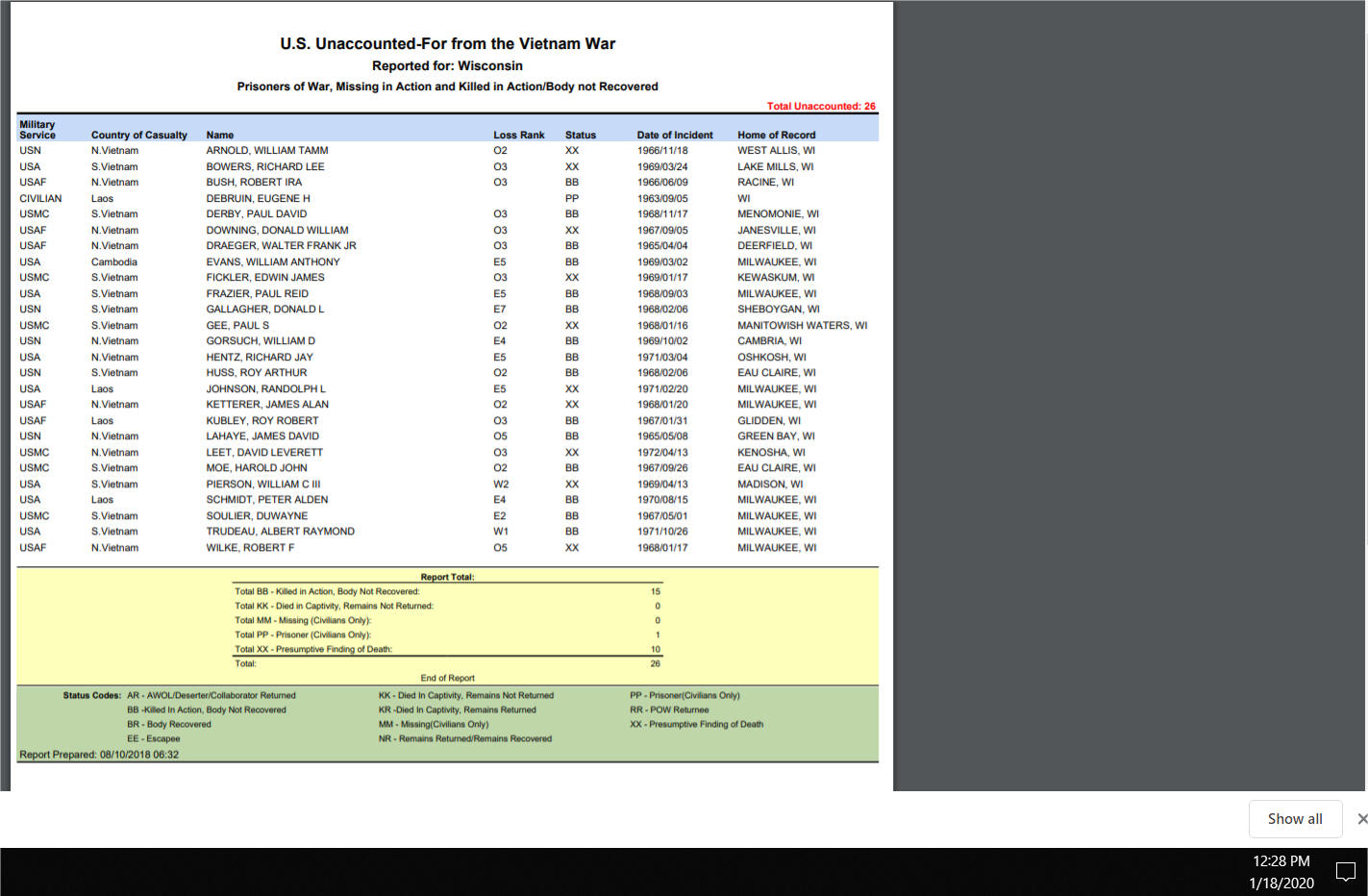
DEBRUIN, EUGENE HENRY
Name: Eugene Henry DeBruin
Rank/Branch: U.S. Civilian
Unit: Air America
Date of Birth: 01 April 1933
Home City of Record: Kaukauna WI
Date of Loss: 05 September 1963
Country of Loss: Laos
Loss Coordinates: 164245N 1061021E (XD250480)
Status (In 1973): Prisoner Of War
Category: 1
Acft/Vehicle/Ground: C46
Refno: 0018
Other Personnel in Incident: Joseph C. Cheney, Charles Herrick (killed in
crash); Chui To Tik and 3 other Thai nationals (names unknown) (all captured)
Source: Compiled from one or more of the following: raw data from U.S.
Government agency sources, correspondence with POW/MIA families,
published sources, interviews. Updated by the P.O.W. NETWORK in 2007.
REMARKS: ESC W/D008 NFI-CREW PIC PUBD
SYNOPSIS: During the 1950's a deteriorating political situation in Laos had
allowed NVA troops and Pathet Lao guerrillas to seize the Laotian panhandle
from the Royal Lao Army. Prevented by Geneva Accords from having a large
military presence in Laos, the U.S. established a "Program Evaluation
Office" (PEO) in 1958 as a CIA cover for anti-communist covert actions. One
activity, begun in 1958, used Meo tribesmen for a small pilot guerrilla
program, which soon became the largest clandestine army in CIA history. In
the first year, using U.S. Special Forces White Star teams as PEO
"civilians", a few CIA officers and 90 elite Thai Border guards, an army of
9000 Meo was trained for behind-lines guerrilla activity. Within 10 years,
the Meo army grew to over 40,000 guerrillas, becoming the most effective
fighting force in Laos.
The CIA's covert airline, known as "Air America" (AA) supported the Meo as
well as numerous other CIA-backed clandestine guerrilla armies. With the
escalating war, a large US military presence guaranteed that Air America
could operate in relative obscurity. With little fanfare throughout the war,
AA fought in the frontlines of unconventional war. AA pilots flew "black
missions" over China, North Vietnam and the Laotian panhandle. AA flew in
every type of aircraft from 727 jets to small Cessnas and junk aircraft,
transporting everything from combat troops (alive, wounded or dead) to baby
chicks, dropping rice to refugees and specially trained Nung trailwatchers
into denied areas. AA contracted both with the Drug Enforcement Agency (to
track international drug smugglers) and with the Meo (to haul its annual and
valuable opium crop).
As U.S. forces pulled out, AA picked up the slack, straining to maintain the
status quo. The communists drove the Meo from their homelands in the early
1970's, and as the Meo retreated, AA was in the position of hauling (and
feeding) tens of thousands of refugees. There were problems as the CIA fell
under Congressional scrutiny of its world-wide paramilitary activities and
public pressure to divest itself of Air America. South Vietnam's rapid
collapse in 1975 signified the end of the clandestine war that began in
Vietnam thirty years earlier.
On September 5, 1963, an Air America C46 aircraft was hit by ground fire and
crashed about 2 kilometers from Tchepone, Savannakhet Province, Laos. Eugene
DeBruin, Chui To Tik and two Thai nationals parachuted to safety, but were
immediately captured by the Pathet Lao. Two crew members, Joseph C. Cheney
and Charles Herrick, were killed in the crash.
Later, the the Pathet Lao photographed DeBruin and four others prisoners and
published a leaflet naming the five as their prisoners. Several times during
their captivity the entire crew was moved to different locations within
Savannakhet and Khammouane Provinces.
In early July 1966, Eugene and six other prisoners made an escape. However,
only two of the seven, Dieter Dingler and one of the Thai nationals who was
part of Eugene's crew, reached safety. One report stated that DeBruin was
killed in the escape attempt, but the Thai national reported that DeBruin
was last seen attempting to reach high ground in a classified location.
Eugene's family has not stopped looking for answers. They were able to find
a report that Eugene may have been alive as late as January 1968. His
brother, Jerome traveled to Laos in 1972 in search of information.
Although the Pathet Lao openly admitted holding American prisoners of war,
they insisted that the U.S. negotiate directly with them to ensure their
release. The U.S. never negotiated or recognized the Pathet Lao, and as a
consequence, not one of the nearly 600 Americans lost in Laos (many of whom
were known to have survived their loss incidents) was ever released.
As reports mount that Americans are still alive in Southeast Asia, the
Debruin family wonders if one of them could be Eugene or one of his crewmen.
========================
http://www.wisinfo.com/postcrescent/news/archive/local_10435445.shtml Posted
May 26, 2003
Combined Locks family seeks brother lost in Laos
By Angie Gaspar - Post-Crescent staff writer
COMBINED LOCKS - Dar DeBruin-Hein was only 4 years old when her brother
Gene's C-46 airplane was shot down during the Vietnam War. Her memories of
the nightmarish phone call her family received remain clear today, 40 years
later. "It was a fall day, Sept. 5. It was a real nice sunny day, and we got
the call," said DeBruin-Hein, of Combined Locks. "I remember my dad
answering the phone, and I remember my dad making everyone be very quiet."
Next the family draped a map across the table to find out where Laos was. "I
remember it vividly," DeBruin-Hein said. "I remember writing letters to the
president and senators, and getting boxes of letters and sending them." In
1963, Buchanan native Gene DeBruin was a 30-year-old civilian "kicker" when
he was forced to parachute out of his fired-upon plane. He survived the
crash and became a Pathet Lao prisoner of war in southern Laos. A kicker's
duty is to kick pallets of food, in this case buffalo meat and dry rice, out
the airplane door to aid the refugees below. Before the Vietnam strife,
DeBruin was a staff sergeant with U.S. Air Force from 1952 through 1956. He
then worked as a smokejumper and received a degree in forestry at Montana
State University. Then he volunteered as a kicker with Air America. He had
plans of joining the Peace Corps after his short stint as a kicker,
according to DeBruin-Hein. DeBruin's plane had veered slightly off-course
when he and six others were forced to the ground by their enemy. Gene's
brother, Jerome "Jerry" DeBruin, of Toledo, Ohio, said there were seven crew
members, including three Americans, three from Thailand and one from Hong
Kong. Jerry said the pilot and co-pilot died on impact, but the five
passengers survived to be taken prisoners. As prisoners the men were kept
together. In his personal account published in Vietnam Magazine and later
online, Jerry said there was hope within months after the crash that Gene
would be released, but months turned into years as Gene was shuffled from
one prison camp to another. The five men then planned an escape, in May
1964, that was successful for three days, but they were caught when they
went to a watering hole, Jerry said. They had limited food due to the dry
season and drought. "Gene overheard the guards saying they were going to
kill the prisoners because they had no food for them," Jerry said. Two other
Americans joined the prisoners in December 1965 and January 1966. "The seven
climbed a karst, divided into four groups to avoid detection, shook hands
and said goodbye," Jerry wrote. That was July 1966. The second escape
attempt for DeBruin was unsuccessful. Some of his comrades escaped and made
it out, but DeBruin never returned home. "He is still a POW who needs to be
accounted for," Jerry said. DeBruin-Hein said the prisoners decided to
attempt escape in pairs during the rainy season, and they packed dry rice.
One American and one Thai were rescued. Another American was killed,
according to Jerry's findings. Gene decided to stay with a Chinese prisoner
who was having difficulty walking due to an infection. There was some
discussion of leaving him behind, according to DeBruin-Hein, but Gene was
not willing to leave him to die. "Gene was always the peacemaker of the
group," DeBruin-Hein said. "He said that he would go with the Chinese man,
determining that it's all or none." Gene never made it home, but he could
not be confirmed dead, either. Bob Tennison of Little Chute, a friend of
Gene's since elementary school, attended St. Mary's Elementary and Kaukauna
High School with him. "He was a kind of quiet guy, wasn't real boisterous at
all, a real nice fellow," Tennison said. "He was never a troublemaker or
anything like that." Tennison said he was surprised about all the things
Gene did, including becoming a smokejumper, getting his own small plane
pilot license, working as a ski instructor, and being in the military. He
said Gene seemed too easygoing to be involved in such things. "I felt pretty
sad that he was shot down. I knew his dad really well; he was down about the
thing," Tennison said. "They were really after the government to try to find
him." The search continues through Gene's brother Jerry. "We're still
actively involved in trying to get my brother, if living seek his release or
if dead bring his remains back to the United States for proper burial,"
Jerry said. "We're going to be starting our 40th year. We're optimistic; the
search goes on. The goal remains in crystal clear focus and is attainable."
Jerry said he continues to track various prisoners and people who stayed
behind after the war. He is covering all possibilities in finding out if
Gene is alive. The government is still excavating graves, he said. Gene was
known as an outdoorsman, as he enjoyed hunting and fishing, and for being
involved in his own neighborhood baseball league located in his family's
Buchanan farm field. He was the second oldest of 10 children. "I remember
getting gifts, and he wanted to send me a Husky dog, but my dad said no,"
DeBruin-Hein said. "My sisters liked to clean out Gene's clothes pockets
because he always had Juicy Fruit gum." A part of Gene remains in Jerry's
blood - the love of baseball. "Gene taught me how to keep score in
baseball," Jerry said. "He was my mentor and still is my mentor. You
definitely take on characteristics of those who are older than you." Jerry
grew up playing on the farm baseball field designed by Gene, where he
learned how to play and love the game. Later he was offered a minor league
contract with the Chicago White Sox, but didn't take it because of his
responsibilities on the farm. Jerry played college baseball for four years,
and he recently published "Mud Hen Memories" in honor of Gene. A longtime
friend of Gene's, Bob Wenzel of Little Chute, said he also played baseball
with Gene in the neighborhood league. Wenzel also spent time with the Air
Force around the same time Gene did. They graduated together from Kaukauna
High School. "I was a city slicker; he was a farm boy," Wenzel said. "They
called him 'Hunk.'" Wenzel said he never understood why Gene, with his
college education and quality life potential, decided to serve as a civilian
kicker during the Vietnam War. "He was a kid that felt strongly toward
helping people, and he got shot down doing mercenary work," Wenzel said. "My
feeling is that he died doing what he wanted to do. Sometimes the Lord only
wants the good ones."
Angie Gaspar can be reached by e-mail at pcnews@postcrescent.com
===============
Senate Select Committeee 1993
Laos                    Eugene H. Debruin
                            (0018)
On September 5, 1963, an Air America C-47 transport on which Mr.
Debruin was a "kicker" was shot down by hostile ground fire over
Savannakhet Province. It crashed approximately twenty two
kilometers northeast of Muang Phine. Eugene Debruin and four non-
U.S. crewmen parachuted out and were captured. According to the
Pathet Lao, the remaining two American civilian crewmen who were
not reported to have bailed out died in the crash.   On May 31,
1966, the Pathet Lao spokesman in Vientiane, Soth Phetrasy,
confirmed that Mr. Debruin was alive and in captivity.
Information from an American escapee and a Thai captured with Mr.
Debruin recounted Mr. Debruin's capture and prison chronology
through July 3, 1966, the last time they knew Mr. Debruin to be
alive with them in Khammouane Province. Accounts of the prison
escape include information that four of the seven prison guards
were killed during the escape attempt. One Thai who escaped and
was recaptured was not killed after recapture.
A photograph of Mr. Debruin was later obtained by Air America in
May 1969 and showed Mr. Debruin in captivity circa 1965. A credit
card and other information concerning the dead pilot was later
obtained through private sources.
On September 25, 1982, Pathet Lao Colonel Khamla Keuphithoune told
a visiting National League of Families delegation that Eugene
Debruin was killed attempting to escape from captivity.
Information has surfaced from American POW hunters throughout the
last half of the 1980s and into 1991, as well as from Lao and Thai
residents of Thailand, which asserts that Mr. Debruin is still
alive in Laos and living freely with a Lao wife and children in
Khammouane Province. The Debruin case is well known in the private
POW/MIA community due to extensive efforts and informational
leaflets distributed by Mr. Debruin's brother who for many years
has attempted to recover his brother. The Joint Task Force Full
Accounting has received information regarding Mr. Debruin's grave
site and is currently planning to excavate it.


Bamboo Cage, Nigel Cawthorne
Page 69
Chapter 5
The Living Dead
So who were these men who were left behind? Who were the discrepancy cases -
the eighty men who the Americans knew to be alive in captivity but who did
not appear on the lists handed over by the North Vietnamese? The names of
these men are, of course, classified, but they included men like Gene
DeBruin. (1)
DeBruin was a kicker for the CIA airline Air America. (The kicker's job was
to roll the pallets out of the back of the aircraft when it was making a
supply drop.) DeBruin was also photographed in captivity, along with four of
his crewmen. (2)
Air America was used to supply the US-backed secret army in Laos, and in
1963 DeBruin was on a mission dropping sacks of rice and buffalo meat when
his C-46 was shot down. A few weeks later the Pathet Lao acknowledged that
they had captured DeBruin, three Thai crewmen - Pisidhi Indradat, Prasit
Promsuwam and Prasit Thanee - and one Chinese, To Yick Chiu. In 1965 their
photograph appeared in a Pathet Lao publication. They were pictured in a
village called Tha Pa Chon, near one of the seven prisons known to be in the
area. When Jerry DeBruin- Eugene's brother- went to Laos, Pathet Lao
spokesman Soth Petrasi confirmed that Eugene was alive and 'being treated
adequately'.
Not everyone believes this, including a US Navy pilot, Dieter Dengler, who
met DeBruin in 1966. Dengler, the only American prisoner to escape from
Laos, told of being held in almost primeval conditions and of being
subjected to horrible torture. In one of the worst camps he met a
red-bearded Caucasian who introduced himself as Gene DeBruin. (3) Dengler
and DeBruin escaped, but DeBruin was recaptured. Dengler believes, however,
that DeBruin may still be alive. He says that during his period of captivity
prisoners were repeatedly told that they were being held because they were
very valuable. (4)
===========
           
Then a June 9th White House memorandum from the situation room informed
Henry Kissinger that "The Pathet Lao chief representative in Vientiane . . .
told our Embassy officer that further information on two . . . acknowledged
POWs (Hrdlicka and Debruin) must await the formation of a new coalition
government in Laos."
In June 1973, a White House message from Henry Kissinger to the American
Embassy Charge d'Affairs Dean stated "Le Duc Tho complained to me last week
that you had mentioned US-DRV understanding regarding U.S. prisoners
captured in Laos in your talk with Phoumi Vongvichit. We obviously cannot
afford to give Hanoi this sort of grounds on which to abort their
understanding with us."


=====================================================================================
From: "chaokhao"
To: <info@pownetwork.org>
Subject: eugene debruin
Date: Sat, 4 Aug 2007 20:37:13 -0500
I spent many years with the USG in Laos and several of the AAM crew members you list in your site were working for me when they went down.  I appreciate your efforts in keeping this issue before the American people.

However, in reading the synopsis on Eugene De Bruin I believe you have inadvertently picked up a piece of misinformation and incorrectly included it: 

 
"AA contracted both with the Drug Enforcement Agency (to
track international drug smugglers) and with the Meo (to haul its annual and
valuable opium crop)."
 
AAM did, indeed contract with DEA. One of the DEA teams was stationed at the site where I ran the Air Ops.  But I do not believe it can be documented that AAM knowingly carried opium for the Hmong (Meo) or for anyone else. In fact, studies by Dr. Leary and others refute this.  Did AAM unknowingly carry opium? Sure. I'm sure I unknowingly allowed opium on some of the aircraft that I controlled. Opium was legal in Laos until the early 1970s so it was a legal product.