|
Name: Cole Black Other Personnel in Incident: (none missing) |
|
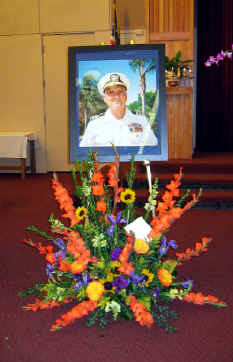 |
Black, Cole
Deceased 11/09/2007
|
Name: Cole Black Other Personnel in Incident: (none missing) |
|
|
Source: Compiled by Homecoming II Project from one or more of the
following: raw data from U.S. Government agency sources, correspondence with
POW/MIA families, published sources, interviews. Updated by the P.O.W.
NETWORK 2023.
REMARKS: 730212 RELSD BY DRV
SYNOPSIS: The Vought F8 "Crusader" saw action early in U.S. involvement in
Southeast Asia. Its fighter models participated both in the first Gulf of
Tonkin reprisal in August 1964 and in the myriad attacks against North
Vietnam during Operation Rolling Thunder. The Crusader was used exclusively
by the Navy and Marine air wings (although there is one U.S. Air Force pilot
reported shot down on an F8) and represented half or more of the carrier
fighters in the Gulf of Tonkin during the first four years of the war. The
aircraft was credited with nearly 53% of MiG kills in Vietnam.
The most frequently used fighter versions of the Crusader in Vietnam were
the C, D, and E models although the H and J were also used. The Charlie
carried only Sidewinders on fuselage racks, and were assigned such missions
as CAP (Combat Air Patrol), flying at higher altitudes. The Echo model had a
heavier reinforced wing able to carry extra Sidewinders or bombs, and were
used to attack ground targets, giving it increased vulnerability. The Echo
version launched with less fuel, to accommodate the larger bomb store, and
frequently arrived back at ship low on fuel. The RF models were equipped for
photo reconnaissance.
The combat attrition rate of the Crusader was comparable to similar
fighters. Between 1964 to 1972, eighty-three Crusaders were either lost or
destroyed by enemy fire. Another 109 required major rebuilding. 145 Crusader
pilots were recovered; 57 were not. Twenty of these pilots were captured and
released. The other 43 remained missing at the end of the war.
Commander Cole Black was the pilot of an F8E sent on a combat mission over
North Vietnam on June 21, 1966. His flight route took him northeast of
Hanoi, where he was shot down near the border of Lang Son and Ha Bac
Provinces about 15 miles southwest of the city of Lang Son.
For the next 7 years, Black was held in various prisoner of war camps,
including the infamous "Hanoi Hilton" complex in Hanoi. He was released in
the general prisoner release in 1973.
Since the war ended, nearly 10,000 reports relating to Americans missing,
prisoner or unaccounted for in Southeast Asia have been received by the U.S.
Government. Many authorities who have examined this largely classified
information are convinced that hundreds of Americans are still held captive
today. These reports are the source of serious distress to many returned
American prisoners. They had a code that no one could honorably return
unless all of the prisoners returned. Not only that code of honor, but the
honor of our country is at stake as long as even one man remains unjustly
held. It's time we brought our men home.
=====================
Cole Black retired from the United States Navy as a Captain. He and his wife
Karen live in California.
In late 2002, Karen authored CODE OF CONDUCT, a novel, based on her own
and her husbands experiences as a Vietnam, former Prisoner of War.
It is available at www.code-of-conduct.com.
=====================================
======================
More info http://www.veterantributes.org/TributeDetail.php?recordID=33
| A REAL TOP GUN (My memory of an ex-POW) by Dan McKegney (Copyright 2001) reprinted with permission Among my reasons for writing this story is for Kristin,Sarah, and Elicia, my lovely and intelligent nieces. All are much smarter than I, though maybe each can gain something by reading this story. The something I hope that each can gain is my wish that they each may be moved to explore the nature of some important concepts such as loyalty, courage, honor, respect, human endurance, and love of country through their knowledge of the contributions and sacrifices of Captain Black, one of my heroes. My hope also is that perhaps they may come to understand something of war and, more importantly, to appreciate the importance of and price paid for peace and freedom. Who knows, maybe one day they will decide to seek those aviator "wings of gold". OK, girls. enjoy and learn from the following: "Good morning, Captain Cole." Just seconds after the last word left the tip of my tongue, I knew that I’d screwed up. Screwed up big time. But it was too late to correct my mistake. His name was Cole Black. Captain Black, if you please: an O-6 Naval officer, equivalent in rank to a bird colonel in the Army, Marine Corps, or Air Force. He had been greeting attendees to the Monday morning Command staff meeting as each person approached the doorway. My nervousness in June 1979 about attending my first-ever such meeting at Naval Air Station, NAS, "Good morning, Captain Cole", I had said. What a barely functioning idiot I was. Of that I was certain. Surely, I thought later, and for the good of humanity, I deserved to be issued my formal Idiot's License. I'd just passed the tepid requirements for such licensing. Despite my mistake, I recall that Captain Black had simply smiled, shook my hand, and acted as if nothing out of the ordinary had just happened. "Good morning, Dan" is how he replied, while obviously excusing my "civilian" gaff. Or at least I wanted desperately to believe that my first faux pas in protocol had been somehow overlooked. Less confident than ever before, I proceeded into the meeting room to take my seat towards the rear of a long, rectangular table for my first-ever Command level staff meeting at NAS Miramar. As the Executive Officer, XO, of NAS CO, during those Monday morning staff meetings. Both the CO and XO sat at the head of that long table, around which was seated civilian personnel Department Head. During those meetings Captain Black would interject his comments, opinions, and humorous remarks. Everyone would quietly listen as he spoke. There always seemed to be a kind of additional level of respect that would be accorded to Captain Black by that Monday morning assembly of Department Heads. One could just feel it. Additional respect was in the air. It was palpable. And, rightly so. ************ Naval Air Station Miramar was a special place in 1979. Captain Black, the XO there, was a special man. By the time he was re-assigned to another Navy duty station in 1981, I had by then worked for him for about two years. In 1979 NAS Miramar was also known as " for training Navy and Marine Corps fighter pilots in the life and death aerial ballet of dogfighting in jet-powered machines far above the earth’s surface. "Fightertown the 1986 release of the movie Top Gun, starring Tom Cruise. Maverick, the young fighter pilot Cruise portrayed in the movie, was similar to the Captain Black I knew: both had a boundless energy, an enthusiasm for what they were doing, and a clarity of purpose. There the similarities ceased, however. In 1979 Captain Black was by then a desk-bound Navy fighter pilot, a Naval officer charged with administrative duties. Maverick was just a fictional character, a celluloid jet jockey. Captain Black had been the genuine article, the real deal, a bona fide sky warrior. He had possessed the "right stuff". He was also a man who'd spent nearly seven years as a prisoner of war, a POW, in By 1979 I was a civilian in my early thirties working for the Navy. I was a "sandcrab" in charge of civilian personnel administration at Department Heads. I had served a 4 year enlisted tour with the Air Force years before, getting out in 1971. I'd served my year in 1967-1968, at Tan Son Nhut Air Base( down in 1966 while flying his F8E Crusader over ever got to the South. He spent nearly seven years in POW. In 1973 he was released from the Hanoi Hilton during Operation Homecoming. Now in 1979, Captain Black was my immediate supervisor, my boss. I knew of his past, or at least that part of his that most closely paralleled that of mine. We never spoke about it. Captain Black, or "XO", as I soon learned to call him, was a little shorter than my nearly six feet. Yet, he was thickly and strongly built and had a brisk and hearty handshake. An energetic man, his dark eyes would fixate on anyone with whom he came in contact as he greeted people with a broad, friendly smile. Even though he was in his late forties in 1979, one could not help but notice his youthful appearance, an appearance which starkly contrasted with his nearly white hair. *********** "Dan, XO here. Can you come down to my office as soon as possible? Yes sir, will be there shortly", I would reply as I started to hang up the phone and reach for my topcoat. I was always glad to get a phone call from the XO, even though I knew it meant that something was "up" in the civilian side of the house---something that I’d probably not heard about like a Congressional inquiry regarding one of our civilian employees or a letter from our civilian labor union that had been sent directly to the CO. I always expected the unexpected when asked by Captain Black to come to his office. Though assigned to desk duty, Captain Black was thoroughly a fighter pilot in the truest sense. On a small table across from his desk there stood a small, hand-held radio receiver. It was always on, monitoring the aircraft/tower transmissions at without those crackling radio sounds between the fighter aircraft. Whether taxiing on the runway, taking off, or in the process of landing, the tower/aircraft radio transmissions could clearly be heard in the background during our meetings in his office. Occasionally, his attention would be momentarily diverted if there were transmissions of particular import, as only he would know. On one occasion, and after hearing a particular radio exchange between aircraft and tower, he invited me outside the Miramar Headquarters building to view the runway action. There I proudly stood next to him, while my eyes followed the direction his arm showed as he pointed towards a fighter plane attempting a landing at the action, though without fully understanding. While his body was earthbound, Captain Black's spirit was surely with the pilot landing that plane. That plane touched down and stopped safely. October 1980. An open house and air show at NAS Miramar, featuring the "Blue Angels". Though he was XO at Captain Black, thoroughly a fighter pilot, helped to honcho that show. E-2s, A-7s and 6s, F-4s, F-14s, F-5, F-8s and A-4s all took off at about 1230 hours. There was a flying formation as the national anthem was played. The U.S. Navy Parachute Team did a demonstration for the assembled audience, members of the public. There were many other demonstrations of flight operations. The finale involved an aerial demonstration by the "Blue Angels"... Navy fighter jets swooping and swarming across and into the a person, all the while. I knew that Captain Black was pleased by the air show. ************* Monday mornings at NAS Miramar. Those Command staff meetings began sharply at 0900. Now that I think back I'm certain that each of the attendees, and in his own way, must have listened to Captain Black with a certain sense of respect and envy. Yes, envy. Certainly not for the isolation, the torture and imprisonment that he had endured for so many years as a POW. Rather, it was an envy, a jealousy, regarding the depth of self-knowledge that he seemed to possess because of his POW experience. His was a kind of self knowledge that none of us sitting around that table had. For none of us, I believe, had been through a similar crucible of human experience. How would I, or any of us for that matter, have responded to the adversity that Captain Black had experienced? Would I have been as strong as he? Who would I have become? Would I have endured? What would I have become? Did I have the grit, theresolve, resilience to endure as had Captain Black.? I didn't know then, nor do I now know the answers to any of those questions. What I do know is this...if I could fit into my old Air Force uniform, Captain Black, I would salute you, sir. Was a pleasure working for you. There were never any noteworthy exchanges between Captain Black and I regarding is how it should have been. But now is different and it is within today's times that I say to Captain Black: Welcome home, brother. |
|
04/25/17
My daughter in law saw this video that Brad Paisley did on the USS
|
|
|
Ken Burns' Vietnam series on PBS brought back
memories of a POW/MIA bracelet and the soldier
09/28/17
I only knew Cole Black was a POW and that his was
one among hundreds of POW and Missing In Action
names engraved on the $2.50 bracelets that ...
|
|

Dr. Greg McGregor, a geotechnical engineer from St. Paul, cannot possibly foresee how much his life will change nor how much it will be in danger, when he answers a call from his friend, Charley Farnsworth, chief engineer and major stock owner in TINMAN, an international heavy equipment construction company, asking Greg to meet him in L.A. immediately concerning a nine-digit secret he can’t discuss over the phone. Greg is thrust into an unexpected suspense-riddled adventure when he survives a bombing of his house and later watches helplessly from a block away in Denver as his friend is murdered before his eyes. Together with the feisty former professional skier, Corky Gonzales, Charley’s Aspen condo house sitter and friend, they embark on an exciting and dangerous quest to find who is behind the killings and to discover the identity of Charley’s nine-digit secret. Was Charley’s murder orchestrated by someone at TINMAN, or by the drug cartels using the huge heavy equipment returning from South American projects to transport drugs, or by the someone connected with the Environment Movement opposing the construction of the proposed billion-dollar Susitna hydroelectric dam? Or by someone else related to whatever multi-million dollar project Charley had discovered? And why are Greg and Corky targets of killers with far-reaching tentacles? ~ ~ ~ ~ ~ ~ ~ ~ ~ ~ ~ I have just published my second novel, or third if you want to consider the rewrite of Code of Conduct as my second. Both are listed on Amazon in e-book or paperback. I don’t have much control over the price of the paperback, Amazon sets a minimum, probably based on the number of pages, and I have priced them as low as I could. TINMAN is $9.95 and Code of Conduct is $15.95, However, I have more control over the price of the e-Books. They are regularly $4.99, but through the end of May, I am lowering the price on both of them to $2.99. I actually don’t own a Kindle reader, but can pull it up on my computer or my I-Pad and read just like a book. I think they even offer a free Kindle reader. The Kindle probably has some other features, but I’ve been downloading other books I want to read and it works just fine. Below are links to TINMAN, the new thriller. The first is the e-Book; the second one is the paperback version of TINMAN; (In the next week they should both be on the same page-it takes a while for Amazon to link them; third is the rewritten (and much better she said humbly) Code of Conduct, and the fourth is my author page, which actually has both of the E-books attached. If you’re looking for something to do during this “stay-at-home” time, consider reading my books. And if you like them, please go on Amazon and Goodreads to write a review. https://www.amazon.com/dp/0972444939?ref_=pe_3052080_397514860 https://www.amazon.com/gp/product/B0852QB2DW/ref=dbs_a_def_rwt_bibl_vppi_i0 https://www.amazon.com/Karen-Black/e/B08599F4KD?ref_=dbs_p_ebk_r00_abau_000000
Karen Black |
||||||

I originally started writing an autobiography for my family, but a couple of beta readers said it read like a novel, and that I had “such an interesting life” that I should publish it. Not sure if people who don’t know me well will find it interesting, but here’s the information. If you do read it, I would greatly appreciate a review on Amazon. My Amazon home page link (has all four of my books) https://www.amazon.com/Karen-Black/e/B08599F4KD?ref_=dbs_p_ebk_r00_abau_000000
My autobiography, Fortitude, is now available on Amazon https://www.amazon.com/dp/B0C2SW3F4S... Because I chose to print in premium color, the price is high - hard copy is going to be $39.50, (sorry) but I noticed Amazon has it at about $28 right now, which is actually the cost to print, so if anyone is interested in hard copy, it’s available. The e-book is currently available for $2.99 (lowest price I can select). Below is the synopsis:
Refreshingly frank, real-life story of Abandonment, Alcoholism, Abuse, Murder, Love, Tragic Losses, Pushing the Glass Ceiling, Perseverance and Gritty Determination Reviewers’ Comments: “Karen’s life story reads like a novel, one that pulls at your heartstrings, but one readers, particularly women, will find inspiring, She is truly a woman of substance – bold, fearless, defiant, determined, strong and brave. She definitely had an “interesting” life. From a stark early life – born in a charity hospital, abandoned by her father before she was two, living with her grandparents on an Oklahoma cotton farm, her mother’s murder leaving her scarred, and two stomach-clenching accidents that could have taken the lives of two of her children - she pulled herself up by her bootstraps to enjoy a successful and satisfying life, interacting with celebrities, foreign diplomats, and politicians, including presidents. She married at 16 and divorced ten years later. Supporting her four children alone as a single mom on typical “women’s wages” in the 50s and 60s, even for an experienced legal secretary, wouldn’t cut.it. She had to push a lot of gender barriers - like a very short-lived job as a sports reporter, becoming a construction estimator, opening and operating an award-winning motorcycle business in Kansas, (despite never having ridden one before, which provided a few bruises and broken bones) and a commission based auto parts sales job. Combining full-time work and school, she graduated from college and then law school in her 40s, ultimately becomeing a successful businesswoman and later a successful lawyer, specializing in the field of elder law, often working with people with dementia. After meeting “the love of her life” and spending one evening together, she went to work the next morning and told her friend, “I just met the man I’m going to marry.” That man was former Vietnam Prisoner-of-War Cole Black, who, after more than seven years, had returned home to a broken marriage. Devastated, Cole would require a lot of patience (not Karen’s long suit) and persuasion to give love a second chance. Karen’s story is an in-depth look at a time in history many never knew, and others have forgotten – the simplicity of life with her grandparents on Oklahoma cotton farms (one a ghost house) in the early 40s. Imagine, that little girl who was driving a tractor, picking cotton and playing poker at five years old, went on to travel to all seven continents, walk with and pet lions in Africa and sky dive at 80, Fortitude is a riveting read - encompassing a rollercoaster of emotional issues, many difficult choices, and depicts in vivid detail what courage, grit, determination, resilience, a little humor and a spirit to bounce back can accomplish |
||||||
|
CC:
via Mike McGrath......
Congratulations to Karen,
who "made the big time on this New York City billboard!"
|


